DNA Barcoding

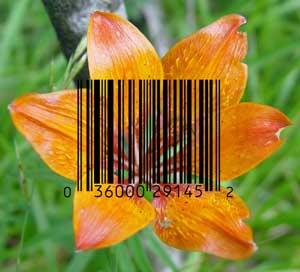
If you purchase a product from a store, did you notice that black and white, thin and thick line with numbers below and that is the unique barcode for that product. According to Oxford Dictionary, a barcode is a machine-readable code in the form of numbers and a pattern of parallel lines of varying widths, printed on a commodity and used especially for stock control and the scanner at the checkout would pick up the different bar codes on the packets and charge the correct amount.
Can we barcode plants and animals? Yes, all species can be barcoded using DNA ie DNA barcoding.

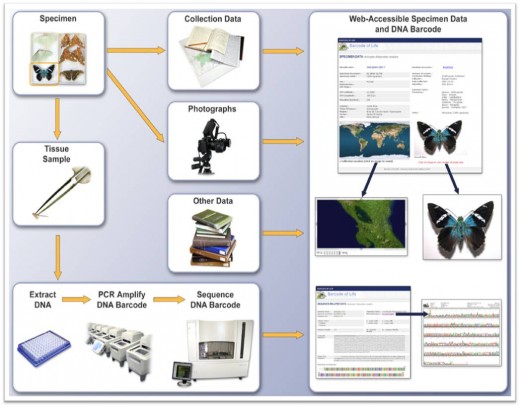
DNA barcoding is a standardized approach to identify plants and animals using minimal sequences of DNA. Barcode target should have short (400-800bp) segment flanked by universal primers.
Inside the cell DNA is primarily located in the nucleus, mitochondria & chloroplast (only in plants).
In plants and animals, barcode targets are different due to different evolutionary line.
Animal Barcode Target -CO I
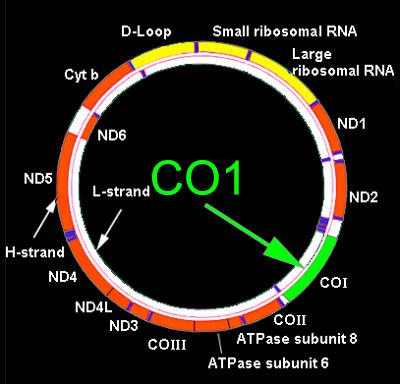
In animals, DNA barcoding target is a short DNA sequence of 600 bp (base pairs) in the mitochondrial gene for cytochrome c oxidase subunit 1 (CO I). Many projects are going using COI as barcode target in animals.
Plant Barcode Targets
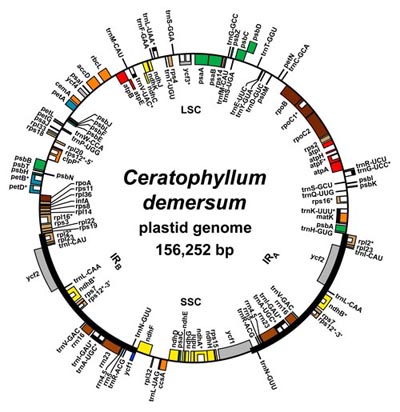
Reason for not getting a suitable universal barcode targets in plants are low levels of variability in the mitochondrial DNA and slow evolutionary rate of chloroplast DNA. Thus the challenge has been to find a region that is sufficiently variable for species identification in plants.
A number of candidate gene regions have been suggested as possible barcodes for plants. A combination of following barcode targets are used in plants.
Some of the barcode targets used in plants
- accD - Acetyl-CoA carboxylase beta subunit
- rpoB - RNA polymerase beta chain gene
- rpoC1 - RNA polymerase beta' (β’) chain gene
- psbA-trnH - Photosystem Q(B) protein- tRNA-His gene
- mat K - Maturase K
- trn L-F - tRNA-Leu - tRNA-Phe
- rpl36-infA-rps8 - ribosomal protein S8 - rpL36
- rbc L-Large subunit of the ribulose-bisphosphate carboxylase gene
- ndh J - NADH-plastoquinoneoxidoreductase subunit J
- ITS(Internal Transcribed Spacer)– 16S rRNA in prokaryotes & 18S in eukaryotes
- YCF 5 - cytochrome c biogenesis protein

DNA Barcoding Methodology